
Best Time to Breed a Dog – How to Determine the Fertile Days of a Bitch
When is the best time to breed a female dog? This is one of the most frequently asked questions among dog owners and breeders. Although breeding between days 10 and 14 after the onset of bloody vaginal discharge is often recommended, this approach is not sufficiently reliable.
The reproductive cycle varies considerably between individual dogs. Ovulation may occur much earlier or later than expected based on calendar calculations.
The most reliable practical approach to determining the optimal breeding time is serial measurement of blood progesterone concentrations, combined with clinical examination and, when appropriate, vaginal cytology.
When Is the Best Time to Breed a Female Dog?
The optimal breeding period is closely associated with ovulation and subsequent oocyte maturation.
Unlike many other mammals, dogs ovulate immature oocytes that require approximately 48–72 hours after ovulation to become capable of fertilization.
Therefore, the most favorable period for natural mating or artificial insemination with fresh semen generally occurs approximately 2–4 days after ovulation.
Accurate estimation of ovulation timing is essential for successful breeding management.
How Many Days After the Start of Bleeding Should a Dog Be Bred?
Bloody vaginal discharge is one of the earliest recognizable signs of proestrus, the initial stage of the reproductive cycle.
Proestrus lasts approximately nine days on average, although substantial individual variation exists. It is followed by estrus, during which the bitch usually becomes receptive to mating and ovulation occurs.
However, neither the onset of estrus nor behavioral changes reliably identifies the exact day of ovulation.
Consequently, the commonly used recommendation to breed a bitch on day 10, 12, or 14 after the onset of bleeding is not applicable to every dog.
In some animals, this approach may result in breeding before or after the optimal fertile period.
How Can You Recognize the Fertile Days of a Dog?
Common clinical signs associated with the approaching fertile period include:
- Changes in the amount and appearance of vaginal discharge.
- Changes in vulvar size and consistency.
- Increased interest in male dogs.
- Acceptance of mating and characteristic tail deviation.
Although these signs may indicate estrus, their diagnostic reliability is limited.
External signs of heat cannot reliably establish the exact time of ovulation.
Progesterone monitoring is therefore recommended when accurate breeding timing is required.
Progesterone in Dogs – Why Is It Important?
Progesterone is a reproductive hormone that plays a central role in the canine estrous cycle.
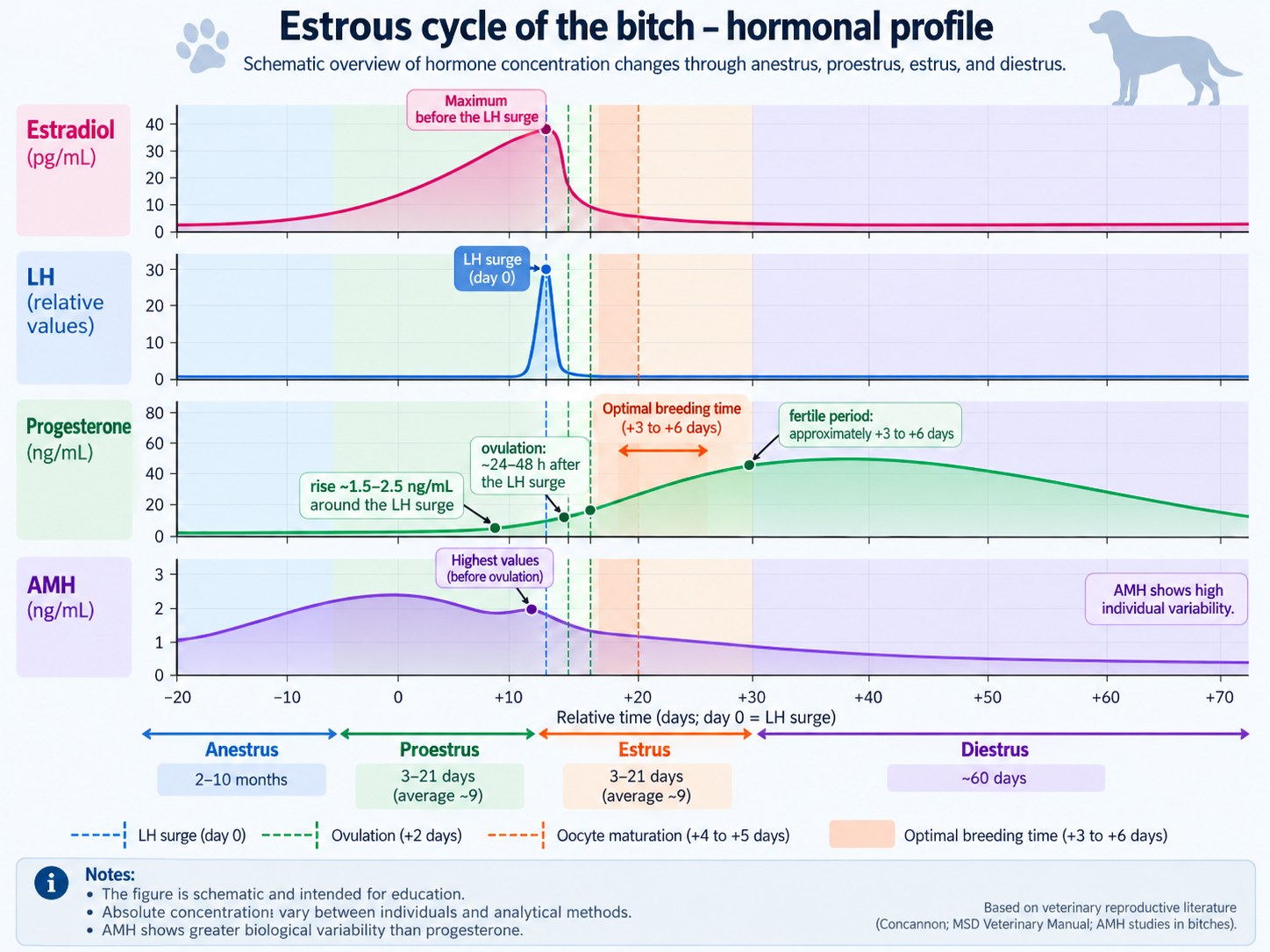
In bitches, progesterone concentrations begin to rise before ovulation as a result of luteinization of ovarian follicular cells.
The initial rise in progesterone is temporally associated with the preovulatory luteinizing hormone (LH) surge.
Ovulation usually occurs approximately 24–48 hours after the LH surge, while the released oocytes require additional time to complete maturation.
Monitoring progesterone concentrations helps estimate ovulation and identify the optimal period for fertilization.
What Progesterone Level Is Best for Breeding?
There is no single progesterone concentration that universally represents the ideal breeding time for every bitch.
The following ranges provide general guidance:
| Progesterone (ng/mL) | General interpretation |
|---|---|
| Below 1 | Usually basal concentration before the preovulatory rise |
| 1–3 | Possible onset of the progesterone rise, around the LH surge |
| 4–10 | Concentrations commonly observed around ovulation |
| Above 10 | May indicate the postovulatory period but does not independently establish breeding timing |
Important: These ranges are approximate and must be interpreted according to the analytical method used and the individual patient.
A single progesterone measurement does not always allow reliable identification of the day of ovulation.
Serial progesterone measurements and evaluation of the concentration trend are considerably more informative.
When Should Progesterone Testing Begin?
In bitches with a clearly identified onset of proestrus, the first progesterone measurement is commonly scheduled approximately five to seven days after the onset of bleeding.
If progesterone remains low, testing is usually repeated after approximately 48 hours.
Once a progressive increase is detected, the testing interval may be shortened to improve the estimate of ovulation timing.
In bitches with an uncertain onset of the reproductive cycle, vaginal cytology can help determine when hormonal monitoring should begin.
Vaginal Cytology – How Does It Help Determine Fertility?
Vaginal cytology is a simple, minimally invasive diagnostic technique used to assess the stage of the estrous cycle based on the morphological characteristics of vaginal epithelial cells.
During proestrus, progressive cornification of the vaginal epithelium occurs, resulting in an increasing proportion of superficial epithelial cells.
During estrus, superficial cornified cells typically represent more than 80% of the epithelial cell population.
However, marked cornification may persist for several days before and after ovulation.
Therefore, vaginal cytology alone cannot accurately establish the day of ovulation, but it is a valuable complementary method when combined with serial progesterone measurements.
A Practical Step-by-Step Guide to Breeding Timing
Step 1 – Identify the Beginning of the Cycle
Record the first day of visible bloody discharge and other clinical signs of proestrus. This provides useful background information but does not reliably predict ovulation.
Step 2 – Perform an Initial Assessment
A clinical examination and, when indicated, vaginal cytology should be performed. Initial progesterone testing should be scheduled according to the reproductive history and clinical findings.
Step 3 – Monitor Progesterone Serially
Initially, progesterone is commonly measured at approximately 48-hour intervals. Once concentrations begin to increase, testing may be repeated every 24–48 hours.
Step 4 – Estimate Ovulation
Consecutive progesterone results are used to identify the preovulatory rise and estimate the approximate timing of ovulation.
Step 5 – Schedule Breeding
For natural mating or artificial insemination with fresh semen, breeding is generally planned approximately 2–4 days after estimated ovulation.
More precise timing and individualized planning are required for insemination with chilled or frozen semen.
Why Is It Important to Use the Same Laboratory?
Different laboratory methods for progesterone measurement may produce results that are not directly interchangeable.
These differences are particularly important within the concentration range used for ovulation timing.
For serial progesterone monitoring, using the same laboratory and analytical method is therefore recommended.
Veterinarians should interpret each result in the context of previous progesterone concentrations, clinical findings, and vaginal cytology when available.
Frequently Asked Questions About Dog Breeding
Can a dog become pregnant if bred on day 10 after bleeding begins?
Yes. However, day 10 may not correspond to the optimal fertile period. Due to individual variations in the reproductive cycle, this timing may be too early or too late.
Is a progesterone concentration of 5 ng/mL the right time for breeding?
Progesterone concentrations around 5 ng/mL are commonly associated with ovulation. However, oocytes require additional time to mature after ovulation. Therefore, breeding should not be scheduled solely on the basis of this result.
How many progesterone tests are needed?
The number of tests depends on the stage of the cycle, the rate of progesterone increase, and the planned breeding method. Several consecutive measurements at intervals of 24–48 hours are often necessary.
Can vaginal cytology replace progesterone testing?
Not completely. Vaginal cytology helps identify the stage of the reproductive cycle, while serial progesterone testing provides a more accurate estimate of ovulation timing.
Is progesterone testing necessary for every breeding?
It is not mandatory in every situation, but it is particularly valuable for planned breeding, previous unsuccessful mating attempts, uncertain estrous cycles, and artificial insemination.
Conclusion
Successful breeding management requires an understanding of the individual characteristics of the bitch's reproductive cycle.
Counting days after the onset of bleeding or relying exclusively on external signs of estrus is not sufficiently reliable for accurate breeding timing.
Serial progesterone measurement, supported by clinical examination and vaginal cytology, represents one of the most reliable approaches to estimating ovulation and planning fertilization in dogs.
Reproductive Laboratory Diagnostics at VetPro
Laboratory progesterone measurement is an important component of canine reproductive diagnostics. Appropriate sampling schedules and professional interpretation of results support more reliable breeding management.
For information about available laboratory tests, sample collection, and submission requirements, please consult the VetPro laboratory test catalogue or contact our team.
Author: Dr Strahinja Medić
Originally published: 31 July 2024 (Serbian article).
Disclaimer: This article is intended for educational purposes and does not replace individual veterinary assessment.
References
- MSD Veterinary Manual. Breeding Management of Bitches.
- University of California, Davis. Ovulation Timing in the Dog.
- University of California, Davis. Breeding Management of the Bitch.
- Comparison of a Point-of-Care Analyzer With a Chemiluminescent Immunoassay for Serum Progesterone Measurement in Breeding Management of the Bitch. Frontiers in Veterinary Science, 2021.